2016-05-17

Stryd Blog: My Background

My first post as a Stryd Ambassador was meant to introduce myself to the rest of the early adopters:

Hello, follow Stryders! I'm Bryan Guido Hassin, a 37-year-old green tech startup entrepreneur based in Chapel Hill, North Carolina, USA.  I played [American] football through university (Go Rice Owls!) but now I run and play beach volleyball as more "life long" sports. Having spent the first half of my life never running more than 100 yards in one go, it's now a fun challenge to tackle (pun intended) longer distances, especially on trails and with obstacles. I'm primarily interested in short and middle distances, although I will run longer distances on occasion as a way to experience beautiful places.

Many moons ago I had the opportunity to work out with some of the top strength and conditioning coaches in the NFL. They impressed upon me that their goal was to help their athletes achieve their maximum genetic potential - within the constraints of the enormous demands on their time and energy. Their athletes weren't working out all day every day; on the contrary, they were taking a surgical, "rifle shot" approach, using the minimum amount of training to achieve the maximum result. Their emphasis of recovery, mobility, and injury prevention over training stress was a real eye opener to me.

As a CEO, I also have enormous demands on my time and energy but I find that I am most effective when both my mind AND body are in peak condition. Motivated by what I learned from the NFL coaches, I am always searching for tools that will help me work smarter-not-harder to improve my physical conditioning. Every year I get older, this approach is increasingly important as I seek to prevent injuries as well - i just don't recover from them as quickly as I did when I was 18!

This quest for smarter training methods is what led me to Stryd. Cyclists have been using power meters for decades to optimize training so I was intrigued by the prospect of doing the same for running. I run a lot of interval and repetition workouts in which heart rate is all but useless as a metric - both for the interval and for the recovery period. Power offered me a much more instantaneous measurement of my output.

Training by power is especially interesting now that I live in a very hilly locale. We moved here from Houston, Texas, which is as flat as the day is long. Once we arrived in [aptly named] Chapel Hill, I quickly realized that training by pace was useless. Power seemed like an appropriate way to "normalize" pace based on the constantly change grade.

My hopes for Stryd extend beyond training too as I believe that it can be a powerful (again, pun intended) weapon in races, when emotions are tense, paces need to change based on grade, and heart rate is so laggy that, once you realize that it's too high, it may be too late.

Finally I'm hoping that Stryd can be an "always on" coach, of sorts, to help me improve my running form. I've been able to see power decrease while pace remains constant when I focus on certain running form cues so I'm hoping to integrate that type of feedback more tightly into my training.

As a trained scientist/engineer, I'm a natural experimenter. Over the course of this week I'll share with you all some of the experiments I've run with Stryd, some of what I've learned, and some of what I think is still out there to figure out. Thanks for joining me in this journey of discovery and may the Power be with you!

2016-05-16

Running with Power

For the last six months I have been trying out a new gadget for running. It's called Stryd and it's a power meter for runners. Cyclists have been using power meters for decades to optimize their training and racing so I was intrigued by the prospect of applying the same advantage to running.

Why Power?
Whether training or racing, running is all about throttling your intensity: too intense and you will burn out too early; not intense enough and you won't achieve maximum results. There are a few possible metrics to help you throttle your intensity already:

  • By feel: Feeling is a notoriously poor metric of intensity as it is very inexact. Even seasoned runners' feelings are biased by mood, time of day, stage of the run, and myriad other subjective factors.
  • Pace: Pace seems like the right metric since, after all, the goal of most running training is to be able to run faster. In flat environments under controlled conditions, pace is indeed pretty good. However, once you introduce varying terrain into the mix, pacing goes out the window. Try to maintain your flat pace up a long, steep hill and cry as you eventually have to slow to a walk. Try to maintain your track or street pace on a sandy beach and cry as your legs turn to hot butter!
  • Heart rate: The answer to the varying terrain conundrum was long thought to be heart rate - as you climb that hill, slow to the point that your heart rate remains the same since heart rate reflects your overall level of effort regardless of topography or surface. This works well in theory but heart rate is a very laggy indicator. It takes heart rate many seconds - sometimes more than a minute - to catch up to the intensity of exercise, which makes it very inadequate as a running metric. Running by heart rate is like driving while looking only in the rear-view mirror.
Enter power. If you can measure power, you have an exact metric that provides real-time, instantaneous feedback on intensity. Measuring power on the relatively simple mechanical device of a bicycle has been easy but running humans are much more mechanically complex and measuring power on them was elusive - until now.

A brief explanation of running with power by Dr. Andy Coggan, the OG of power training:


There are now at least two running power meters on the market; I backed one of them, Stryd, on kickstarter because I liked their approach. It is a wearable 3D accelerometer that, with knowledge of the runner's mass, calculates work done per unit time (power) in each dimension. It also includes a barometric altimeter so it knows with precision how elevation is changing throughout a run.

The potential benefits of such a device are significant: training smarter with precise intensity, "normalizing" hills during runs, optimizing running form for efficiency, and running perfectly paced races. How well does it deliver? Following are my conclusions from six months of use:

The Good

  • Stryd "just works" right out of the box. Put it on, enter your weight, and you are off to the races. Running with power is indeed transformative: pick up the pace or encounter a hill without slowing down and watch your numbers soar instantaneously. Try out modifications to your running form and see in real-time how they affect your power output. THIS. IS. HUGE.
  • Stryd integrates with the tools I already use. It connects to my Garmin Forerunner GPS watch and is worn on the chest as you would wear any heart rate monitor (It also measures heart rate so simply replaces the heart rate monitor I was previously using.). This means that I can keep using the hardware and software tools I already know and love with Stryd.
  • That said, for those who don't already have other hardware and software, Stryd's Power Center website and mobile app are quite good on their own.

The Bad

  • Accuracy is not as good when running downhill. Because runners actually use power to brake some while running downhill, our power can still be quite high - vs. cyclists, who can coast downhill, using ~0 power. As such, Stryd underreports power when running downhill.
  • If you want access to ALL the data that Stryd records (like power separated into all three dimensions), you have to pair it with the mobile app (because sports watches like my Garmin only support a single power metric). For some like me, who prefer not to run with a phone, that's a negative.
  • There is a dearth of power training knowledge and programs out there. Running by power is still so bleeding edge that there aren't a lot of established "best practices" yet. For some like me, though, that's actually a positive, as we have the opportunity to be at the forefront of pushing new boundaries!

The Ugly

  • Because most sports watches don't include power as an option for running data, you usually have to "hack" the device for it to work with Stryd. For example, I actually have to use a cycling profile to use Stryd with my Garmin Forerunner 920XT. After my device syncs I then have to go into Garmin Connect and manually change each Stryd activity from "cycling" to "running" and I miss out on some of the running dynamics data - even though the Stryd records that data, it just isn't displayed because Garmin thought the activity was cycling, not running. While this aspect of using Stryd was annoying at first, I don't even notice it now and I'm sure that it will go away as companies like Garmin and Polar modernize.

The Amazeballs

  • The most pleasant surprise of all with Stryd has been the team! They are amazingly customer-centric, responding in minutes to any challenges or questions we early adopters have, engaging us in rich discussions about the data we collect, and even involving us in the decision-making process for future. Their product improvements come frequently, often as a direct result of user feedback. If you want to see some of this consumer engagement in action, check out the Stryd forums.

A couple of week ago, I even had the honor of being Stryd's facebook group featured user. This meant that I posted every day about different ways that I used Stryd to run with power. I'll replicate some of those posts here on this blog in the coming days.

2016-04-21

Beach Volleyball - Training with a Pro

Last weekend I had the opportunity to train with a pro beach volleyball player. It was a fun experience and I learned a lot!

As most of you will know, I'm not built for volleyball at all - but I've been playing it for years and really love it. My college girlfriend was a volleyball player and got me into the sport. Tall and lithe, she played with a grace that was the antithesis to my brute force, "muscle through it" approach to most things in life. We didn't play together much but it was enough to get me hooked.

Throughout my time in Houston I played with several different coed partners but I lucked out in that my favorite wingman turned out to be a terrific men's partner. He had been playing much longer and taught me most of what I know about VB - although much of it was biased by his indoor background. We did pretty well together, placing in a few A tourneys in Houston and Galveston. Because he is also an international traveler, he and I have played together in five different countries.

Katie is also into beach volleyball so now she and I play together whenever we can. We'e been very pleased with the thriving beach scene in the Research Triangle. There are dozens of sand courts scattered throughout the area and multiple opportunities to play at different levels every day of the week.

While I was enjoying playing and improving last year, I tore the labrum in my right shoulder, making it painful to hit, serve, or dive on the right side. My mechanics are terrible between my poor range of motion / flexibility and the very indoor-y style of VB (big approaches, big windmill swings) I had been taught, both of which contributed, I'm sure, to my labral tear.

Fortunately my injury did not require surgery and I have been recovering through physical therapy and mobility work. After a layoff from volleyball, I'm back at it now and trying to work on playing smarter rather than harder: being in the right position rather than diving for a spectacular dig, hitting mechanics that save my shoulder rather than swinging away, etc. I just turned 37 and I'm sure that this will become even more important as I get older.

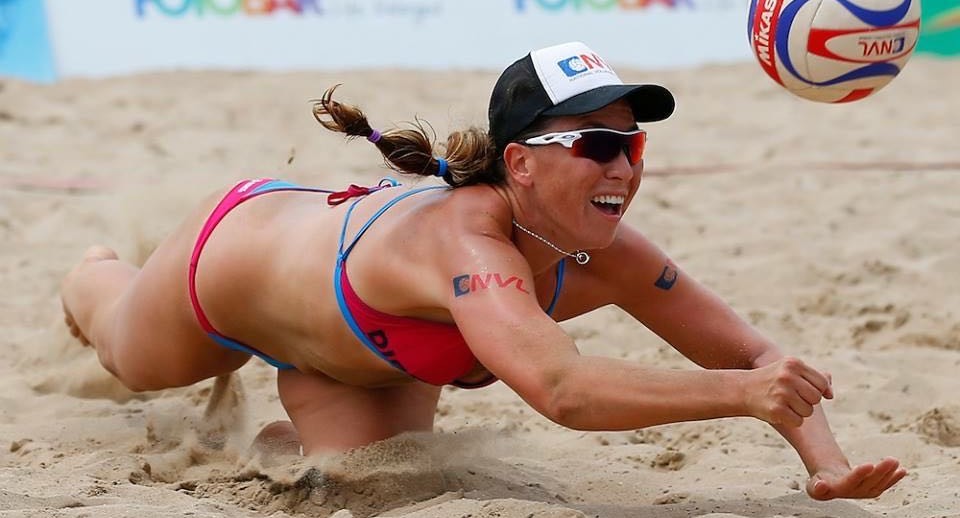
Enter Tarin Keith, a pro beach player in the US National Volleyball League. Tarin rented out one RTP area complex of four courts and "held court" (See what I did there?) last Friday through Sunday. Some of the time she gave private lessons while, at other times, it was open play but she watched, coached, offered advice, and sometimes joined in.


Katie and I (and some of the people with whom we routinely play) did a private lesson with her on Friday and then Sunday we joined for open play to practice our new skills. Katie picked up some hitting tips and for me there were several new learnings:

* passing with my outside foot forward to help control the pass from shanking outside, away from my partner
* getting my hips around to pass the ball forward, in line with my shoulders and hips, rather than shunting it sideways
* setting my platform and then passing with my legs rather than relying on a last-minute elbow "pop" to add height.
* passing in front of me and off the net (vs my previous passing middle and on the net) so that my setter can set me in line with her shoulders and see the court to give me hitting advice - this falls under the mantra of making the game "smaller" on our side of the net.
* "finishing" my bump sets to give my partner plenty of time to approach and time her hit
* setting up outside to approach the net at 45 degrees, increasing my [right-handed] hitting options
* JUMBO!!!!!! - a high looping angle shot that makes a path like a jumbo shrimp :-)

Some of this was new to me and some of it wasn't new per se, but having an experienced coach to demonstrate it and provide real-time feedback/guidance helped me internalize it. Sunday's practice indicated that Katie and I still have a lot of work to do to elevate our game - but working on it is a lot of fun and great exercise.

Many thanks to Tarin (who also co-hosts a volleyball destination training camp in Turks and Caicos - check out her website for details!) for coming out to RTP, to the local VB enthusiasts who helped her organize the weekend, and to Katie for her patience with me as a partner. See you all out in the sand!

2016-03-15

15 Years An Entrepreneur

15 years ago I cofounded my first startup. Now, with seven startups under my belt, some big successes, some small successes, and some, ahem, "less than successes," it's amazing to think about how pivotal that decision to try the entrepreneurial path was.

It was my junior year in college and I had been working part time and summers for UUNET, the world's largest and fastest growing Internet Access Provider, during the peak of the Internet boom. UUNET was amazing when I started there but had grown so bloated and inefficient that I was interested in exploring other options for my last summer before graduation.

Many tech companies - large and small - recruited Rice computer science and electrical engineering majors so I went to career fairs, had interviews, and received several job offers. The best offers came from tech startups. They flew me out to lavish recruiting weekends, paid high salaries, and offered the chance to work on bleeding-edge technologies. Those weren't the aspects that really appealed to me, though; what really interested me was the opportunity to make a meaningful impact on the success or failure of the business.

While I was mulling over the offers, I reconnected with two Rice CS seniors whom I had met during a programming language theory class. They had both accepted job offers from big companies but they wouldn't be starting those jobs until the Fall. They had a [software-based] business idea and intended to spend the entire summer launching a startup around it. If they weren't successful, no worries, they would just start their jobs. If they were successful, though . . .

Long story short: they invited me to join them in starting the venture, something which had never occurred to me before. Now I had a much more complex decision to make: go with one of the "safe bet" options or help start something from scratch.

Of course I decided to cofound the startup. The way I saw it, this was the perfect time in my life to take a big risk; I didn't have kids to feed or a mortgage to pay. Plus I just felt 100x more inspired about the idea of helping to build something from scratch than I did about being a cog in someone else's wheel.

This is, I think, the essence of why I have always (In hindsight, the warning signs have been present since at least elementary school!) been drawn to entrepreneurship: self-efficacy. When the game is on the line, I want the ball - and entrepreneurship is the career equivalent of exactly that. I don't want my destiny anywhere but in my own hands.

The other aspect of entrepreneurship that I really appreciate is its ability to effect great change with no upper limit. Having grown up in the shadow of the space industry, I have always been inspired by the ad astra mentality of solving huge problems. In a capitalist world, entrepreneurship is the most efficient platform for solving such problems today and scaling those solutions up tomorrow.

That first startup was such a bumpy ride. Funded on credit cards . . . Multiple business model changes without a customer in sight . . . and one of our cofounders got scared and dropped out. But it was a grand adventure - and one with a happy ending. Suffice to say, the self-efficacy and scalability were addicting and I've been [ad]venturing ever since!

2016-03-04

Entrepreneurial Leadership

Last week I was invited to give a talk on a topic of my choice to the team of a high-growth startup in Durham. Because leadership challenges often cause friction during times of high growth, I chose to address the topic of entrepreneurial leadership. Check out my video below and let me know what you think!


2016-03-01

Leadership Journey

12 years ago today - 1/3 of my life ago - I accepted my first chief executive role. While I had been elected to and selected for leadership roles during my scholastic and athletic careers, this was the first time a Board of Directors actually hired me for it.

That first chief exec role was tumultuous, challenging, exciting, and rewarding. During my tenure I developed lifelong friendships and grew substantially as a leader. I made many mistakes - but I learned a great deal as well.

Ultimately I learned that leadership could be a great power for good and I shipped off to IMD to expand my horizons and capabilities. Every day since then has been a deliberate step in an ongoing leadership journey.

The journey continues but today I pause to reflect on the big milestone of 12 years ago and how significantly it has impacted my path.

“It's a dangerous business, Frodo, going out your door. You step onto the road, and if you don't keep your feet, there's no knowing where you might be swept off to.”

― Bilbo Baggins, J.R.R. Tolkien's, The Lord of the Rings

2016-02-10

My presentation from the 2016 Distributech Conference

This week I was in Orlando for Distributech, the annual Smart Grid Conference. I made some great connections, did lots of demos, and enjoyed making a brief presentation about one of Smart Office Energy Solutions's client case studies: