2018-03-25

Review: The Last Jedi

The Last Jedi The Last Jedi by Jason Fry
My rating: 2 of 5 stars

This adaptation was OK. Because it was released AFTER the film (vs The Force Awakens, which was not), it is more of a straight, 1:1 transliteration of the film and doesn't offer much that you don't see on screen (with the exception of a deleted film scene and a prologue detailing what Luke's life might have been like if he had never left Tattooine).

Here are a few thoughts in no particular order:
* We get a little more Finn and Rose time so their developing relationship seems a little more believable than in the film. Her "love arc" still seems forced.
* I find the Holdo/Poe subplot to be even more ridiculous in this novelization. In the movie you can try to write it off as possibly the victim of editing but the book, which has all the time in the world to make it seem less contrived, doesn't even bother.
* This novel suffers from the same challenge as many Star Wars books. In the written medium, authors often try to "expand the universe" by giving exotic names to alien creatures and futuristic things. For whatever reason, though, there seems to be NO creativity on Team Star Wars and they continue just to mash together familiar words, hoping that the result will be interesting. Plastocrete. Battering ram cannon. Turbo lifts. Sooooo lame! Many of these elements are in the films too but they can be glossed over there, whereas they have nowhere to hide in the books.
* Similarly, this novel also makes reference to several other extended universe plots and characters - references they weren't able to squeeze into the film. Unfortunately these plots and characters were pretty weak so the references aren't very compelling.
* Per the above, this novel doesn't really fill in any film gaps. If you're hoping that this will, for example, address Snoke's back story, sorry to disappoint you.
* The novel DID, however, make some things clearer for me, especially around Luke. It wasn't evident to me previously that Luke's reconnecting with the Force was the cause of Leia's reawakening and Yoda's reappearance. After rewatching the film, it's all there, but the book somehow drove it home for me. Thanks, book!

Overall it's hard to recommend this novel. It doesn't offer much content that isn't already in the film and stylistically there isn't much to it either. Still, if you're a hard core completionist, it's not a bad read and you can finish it quickly.

View all my reviews

2018-03-13

Review: Artemis

Artemis Artemis by Andy Weir
My rating: 3 of 5 stars

This was an enjoyable read but . . . it wasn't The Martian. Weir does a good job again of weaving real science into this novel but it feels less organic this time and more . . . inserted. Weir establishes a good and consistent voice for his character (I listened to the audiobook, read by Rosario Dawson, who was great.) but I didn't find myself nearly as engaged by her.

Maybe he doesn't write women as well as he writes men or maybe the plot just didn't grab me as much as the "entire planet coming together to bring our boy home" arc of The Martian did. Either way, I couldn't put The Martian down whereas I felt my mind wandering during Artemis and I found myself eager for it to hurry up and finish.

Not a bad sophomore effort, but not great either.

View all my reviews

2018-03-10

Startup Fundraising: The Good, The Bad, and The Ugly

One year ago today, Smart Office Energy Solutions closed a $1.3M angel round of funding. We've accomplished a great deal since then - expanded the team, finished gen-1 product development, obtained all the requisite certifications for our hardware, and built a large sales pipeline - but I find anniversaries to be a good time to pause and reflect.

This is a presentation on startup fundraising I gave a few days ago to entrepreneurship students at the University of Wyoming. In it, I review the pros and cons of several different startup fundraising strategies, using Smart OES and my previous startups as specific case studies.


Toward the end of the presentation, I take a deep dive into Smart OES's three rounds. The quantitative analysis provides some interesting insights:

  • We had a 0% success rate trying to raise funds from people who were not part of our networks. 100% of our investment came from people we knew or people to whom we were introduced.
  • Former colleagues invested the most (in total invested, mean investment size, and median investment size) in my venture. The trust developed by working with or for someone is a real asset in early-stage fundraising.
  • A similar trust clearly is formed in the academic setting as well because a good deal of our investment came through my school networks. Interestingly, Rice contacts invested more (in total invested, mean investment size, and median investment size) than did IMD contacts.
  • Second-degree contacts became much more likely to invest over time. It is helpful, therefore, for startup founders to engage "smart" money (in this case, investors with connections to other investors) early on.
  • Similarly, the value of repeat investors increased over time, demonstrating the value of engaging investors with the capacity to follow on.
  • Geographically, investors in Texas out-invested investors in Switzerland 2:1. However, using my LinkedIn network size (1,100 contacts in Texas; 250 contacts in Switzerland) as a denominator, the Swiss outperformed the Texans on a per capita basis. Most disappointingly, we didn't raise a penny from North Carolina (where I have 300 contacts!) - and not for lack of trying.
  • Unsurprisingly phone calls and in-person meetings were more effective than emailing or messaging on social networks in leading to investment.
We've just opened up a new funding round (with more than 25% already committed by existing investors!) so we're putting these learnings into practice to be better/smarter/faster this time around.

2018-03-02

Review: The Dark Tower Series Collection: The Gunslinger, The Drawing of the Three, The Waste Lands, Wizard and Glass, Wolves of the Calla, Song of Susannah, The Dark Tower

The Dark Tower Series Collection: The Gunslinger, The Drawing of the Three, The Waste Lands, Wizard and Glass, Wolves of the Calla, Song of Susannah, The Dark Tower The Dark Tower Series Collection: The Gunslinger, The Drawing of the Three, The Waste Lands, Wizard and Glass, Wolves of the Calla, Song of Susannah, The Dark Tower by Stephen King
My rating: 5 of 5 stars

Wow! The Dark Tower series really blew me away. I'm not a fan of the horror genre so I have never read any Stephen King novels before. Of course, as a fan of movie adaptations of his non-horror works, I have long known that he does stray from the genre occasionally but I was never terribly motivated to give him a try.

However, The Dark Tower kept showing up on lists of top FANTASY books, and that is a genre that I truly love. Last year, in preparation for the [bad] Dark Tower movie, I decided to give the first Dark Tower novel a try and - BAM - I was hooked!

From the opening lines of the novel, King uses evocative language to captivate the reader. He creates rich, complex characters and an interesting, immersive world that leaves the reader wanting to know more about it - and about how it came to be. With eight novels to date and probably more to come (King has claimed to have been done with the series multiple times before but it keeps calling to him.), the series scratches that itch satisfyingly.

Interestingly, different novels take on very different tones. Some might be considered dark western fantasy; some might be considered time travel mystery; some might be considered dystopian future sci fi. They provide substantial variety - but always with the same core of well developed characters, so there is a mix of familiarity and novelty.

The series began as a few short stories that were kind of mashed up into a novel. Then King had an idea for a follow-on novel. Then another. Then a prequel. Then a three-novel meta-series that would tie the Dark Tower into all of his other works. Then another prequel. Organically The Dark Tower has grown into his magnum opus over the course of more than four decades.

In some ways I think King's reach exceeds his grasp and he stretches a little too far trying to massage tie-ins of his other works into the later books in this series but, still, I found every book to be very interesting without a single disappointing entry.

It's hard for me to qualify a recommendation for this series with "if you like XYZ genre" because the series is so broad and expansive. So, let me leave my recommendation as such: I see now what the big deal is about Stephen King.

View all my reviews

2018-03-01

2018 Winter Olympics Wrap-Up

Another Olympics has come and gone so it is once again time to take a look at who "won" the Games by several different metrics. Per my previous posts, I continue to use a weighted scoring system to tally up Olympic medals by country. This year I once again tracked not just the medal counts but also economic and demographic metrics for each country - you can see my full spreadsheet here.


Norway was the clear victor in medal scores, winning in every category: golds, silvers, bronzes, total medals, and weighted medal score. The top performers by weighted medal score were:
123 - Norway
107 - Germany
89   - Canada
75   - USA
64   - Netherlands
Norway went from a weighted medal count of 75 in 2010 to 80 in 2014 to explode this year - a true success story! Meanwhile Russia has gone the opposite direction, from 91 (#1) four years ago to 37 (#12) this year. Russia was technically banned from competition this year for doping . . . and yet three Russian athletes competing as individuals were caught for doping at this year's games anyway!

Because Norway is so small, it crushed the competition even (especially!) when normalized by population. The top performers by weighted medal score per million citizens were:
23.43 - Norway
5.60   - Switzerland
5.49   - Sweden
4.59   - Austria
3.77   - Netherlands

These countries are all pretty affluent, though, so how do things change if we normalize instead by GDP? Not much! The top performers by weighted medal score per $B GDP (PPP) were:
0.33 - Norway
0.14 - Liechtenstein
0.10 - Sweden
0.09 - Austria
0.09 - Switzerland

We can mix up the leaderboard a little bit if we normalize by GDP per capita. The top performers by weighted medal score per $1,000 GDP per capita were:
2.12 - Germany
1.84 - Canada
1.71 - Norway
1.51 - China
1.35 - Olympic Athletes from Russia

Many congratulations to Norway, a small country that absolutely crushed much larger and richer countries than itself at this year's Olympics - well done! Keep up the good work and we'll hope to give you more competition in four years!


2018-02-26

Escape To Margaritaville

Exactly five lunar years after our last trip to New York City, Katie and I traveled to NYC last weekend and, while we were there, we saw Jimmy Buffett's new Broadway musical, Escape To Margaritaville! Here is my spoiler-free review:


THE GOOD
  • The vocal talent is awesome - especially the women! If you're a Buffett fan, it's really cool to hear familiar songs sung with range, multi-part harmonies, and vibrato! It's especially interesting to hear some classic Buffett songs sung by women, which makes for an entirely new tone - and even meaning - to songs you know by heart. I can't wait to get my hands on the cast recording!
  • The song list is a good mix of well known hits and more obscure songs from the Buffett catalog. 
  • The musical takes full advantage of the medium and creates some truly fantastic scenes. If you're a Buffett fan, you've been waiting your entire life to see the full audio-visual realization of Cheeseburger, Volcano, and more - even if you didn't know it! Seriously; a few of the music numbers are worth the price of admission all by themselves.
  • Some parts of the show are just really, really fun. There is one scene, for example, that makes no sense whatsoever, and seems like more of a "Jimmy said that, if this is a Broadway show, it has to have THIS element in it," but it still totally works because it's so fun. The ending also does a really faithful job of recreating the experience of being at a Buffett concert - so much fun!
  • The show is really self aware. It doesn't take itself or its source material too seriously, which is very coherent with its fun tone. There is subtle - and not-so-subtle - political commentary slipped in too, which I really enjoyed.
  • The show is loaded with references to Buffett songs. Sometimes those are paid off eventually with a musical number but sometimes they are left as Easter eggs for fans. Because the show is still in previews, it's possible that these references are actually "orphaned" setups for different musical numbers that we didn't see in our show because they are still playing around with the final set list but, either way, I enjoyed all the additional references.
  • There are some good characters and plot arcs - especially including some strong women!

THE BAD
  • Many of the songs stop prematurely; one or two verses are sung and then the actors return to their dialog. As I have blogged previously, Jimmy Buffett is a storyteller; each of his songs has its own narrative arc. Aborting the song before it reaches its conclusion felt unfulfilling to me.
  • Many song lyrics were changed to fit the song into the overall narrative of the show. Some of these changes keep the song's intent but some of them completely change the song's meaning. I totally get why they did it and, in some cases, I found it to be quite clever. In many cases, though, it subverted my expectations so kind of took me out of the song. 
  • In a couple of places the show weaves multiple songs together into a revolving medley of sorts. Further to my point above about the song lyrics, in some ways I think it was quite clever (E.g. they blend together Coconut Telegraph and Head Hurts / Feet Stinks, both of which march through the days of the week.) but overall it doesn't quite work for me. I feel like it's almost there but its reach just exceeds its grasp. Again I understand why it was done for narrative purposes but it came at the cost of the music.
  • The crowd, at least at our show, was really timid. You could tell that many people really wanted to sing along but weren't quite sure whether that was encouraged or even allowed. During a couple of numbers - and increasingly as the show progressed - people threw caution to the wind and belted it out, which was really fun. If the show could find a better way to make it clear early on if/when singing along is encouraged, I think it would really enhance the experience.
  • There are some bad characters and plot arcs - unfortunately including the central love arc.


THE UGLY
  • Nothing to see here!

FINAL THOUGHTS

Buffett fans might be disappointed by some of the changes to songs they know and love but overall will love the Broadway spectacle-ization of his canon. Non-Buffett fans may not experience quite the same highs as those who already love the music but also won't have any expectations to be subverted by the changes. Those seeking serious theater should probably stay away (Duh?) but this is a really fun, light-hearted jukebox musical with great music for everyone else. Attending this show will definitely change your latitude/attitude for a few hours!

2017-12-20

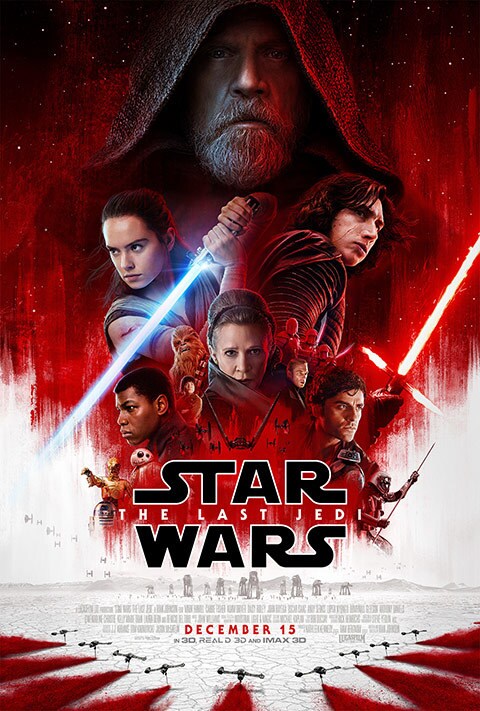
Star Wars: The Last Jedi Review

Katie and I saw Last Jedi opening night, of course, and this was my initial, knee-jerk, non-spoiler reaction: mixed feelings. Some aspects I loved; some I wasn't so sure about. Some comedy was lol; some fell flat. Some emotional beats gave me #allthefeels; some felt unearned. Some plot points confusing but mostly good tension that kept me guessing.


It's a long movie with a lot going on so it has taken me longer than usual to unpack and process. After a second viewing, though, and much discussion, I am now ready to share my full review. WARNING: THERE BE SPOILERS BELOW! OK, let's do this thing.

THE GOOD

  • Let's start with the obvious: this is an audiovisual tour de force. Both times I have seen it have been in IMAX and it has simply been breathtaking - literally! During the silent period during which Holdo's ship light speeds through Snoke's, there were audible gasps all around me.
  • The movie doesn't just look beautiful; the score is amazing as well. John Williams has come through once again. This time he didn't invent any iconic new themes, but he did blend many familiar ones in ways that really heighten the emotional impact of what is happening on screen.
  • The actors brought their A games. There are several emotional scenes and, because the actors killed it, I had all the feels.
  • Last Jedi features some of the best action we've seen yet in the Star Wars universe. Rey and Kylo's fight against the Praetorian Guards was very well choreographed and I loved Kylo and Luke's Samurai / Western standoff on Crait. By giving each character a distinct fighting style they illuminate the differences between them. I also enjoyed Poe's aerobatics more in this movie because they weren't undercut by the extremely contrived, "That's one hell of a pilot," as the were in The Force Awakens. In Last Jedi we get to see what makes him "the best pilot in the Resistance." 
  • There are some genuinely LOL moments (although I'll discuss the downside of them in the BAD section).
  • Yoda returns to form as a puppet and as a whimsical, laughing, old Jedi. I missed this version of him!
  • I'm really glad that Rey's parents turned out to be nobodies. I think the message that you don't have to be born into a "pureblood" family to be strong with the Force is a really great one - and is reinforced by the child we see at the end.
  • The film sets up payoffs far in advance. For example, Kylo says to Rey that she can't be Force projecting herself across such great distance because the effort would kill her. Much later, Luke Force projects himself across a great distance . . . and the effort kills him. Luke tells Rey early on that everything she said was wrong . . . and then tells Kylo the same thing at the end. I appreciate the attention to these little details.
  • While The Force Awakens featured many familiar beats that seemed repetitive, familiar beats in Last Jedi were often subverted. Snoke's throne room showdown, defending a base against ground assault on a white planet, etc. - these are all things that seem familiar but then, to paraphrase Luke, they don't go the way we think. In such a way, these beats "rhyme with" previous beats rather than repeat them. The repeated subversion of our expectations also builds good tension.
  • One way in which expectations are subverted is that, in multiple subplots, our protagonists actually fail to achieve their objectives, which I really like. Because Star Wars is more fantasy fairy tale than it is sci fi, we come to expect our exceptional heroes always to win out - and it really throws us for a loop when they don't. That's refreshing and, moreover, it is thoroughly coherent with one of the movie's messages that it is OK to fail.
  • It was a bold move to kill off not only the primary antagonist (and before the third act!) but also the greatest hero of the franchise. I appreciate that this movie took more risks than The Force Awakens - although not all of them paid off (See below.).
  • I remain really impressed that, after 40 years and eight films, they are still innovating creatures and vehicles. Every movie features some interesting new stuff and this one is no exception.
THE BAD
  • I'm far from the only person to call this out but the Canto Bight subplot didn't work for me. It felt like a monolithic side quest that took a lot of time and really didn't add much to the narrative or characters. Moreover, I was really underwhelmed by their entire realization of Canto Bight. Given an infinite budget and the goal to create a galactic version of a casino planet, what do we get? Basically a terrestrial casino with a slight alien "skin" over it. Really disappointing and not very creative at all.  
  • Although I found some of the comedy pretty funny, I found much of it to be tonally incoherent. In a film that did a good job building tension, setting the stakes, and bringing real gravitas to the plot, I too often found myself pulled out of the movie by jarring humor that just didn't seem to fit.
  • The other side of the expectation subversion coin is that I felt the movie tried too hard - and too frequently - to introduce "twists." From the opening bombing run to the throne room showdown, to Holdo's light speed maneuver, the film tries over and over again to lure you into thinking things will go one way only to reveal that they unsurprisingly are going the opposite way. This trope gets old very quickly for me. Some reveals I thought were fantastic - like Luke Force projecting himself - but these myriad others were cheaper and generally unnecessary.
  • The basis for a major portion of the plot makes no sense. Fuel isn't necessary to maintain a constant speed in space; it is necessary to accelerate (and possibly maintain basic ship functions). If the Resistance ships were lighter and faster than the star destroyers, they should have been able to run away from them. I don't lean too hard on sci fi movies to get everything right, but this is really basic.
  • I didn't buy the Rose-Finn romance at all. It came out of nowhere and seemed completely unearned. It also seemed cheap that Rose - a career mechanic - was able to pilot a snow speeder deftly at the end. Because . . . the plot required it I guess?
  • For the second movie in a row, Domhnall Gleeson was completely wasted. Hux went from being a total caricature of a petulant child (with poor writing to boot!) in The Force Awakens to being a total caricature of a petulant child and a foil for comic relief in Last Jedi. It makes no sense that this character would be a general at all.
  • And speaking of wasted actors, it was nice to see Gwendoline Christie get a little more screen time in this film but she was still largely wasted. Other than cool armor (Why don't all the storm troopers have it since it seems to be the only armor that actually protects against blaster bolts??) her character doesn't bring much to the narrative and that's a shame.
THE UGLY
  • The worst part of this movie by far was the Holdo-Poe subplot, which felt ridiculous and entirely manufactured. Poe has been described as the best pilot in the Resistance and he is clearly a leader among his squad. It seems entirely goofy to me that he and Leia would not be on the same page regarding the objectives of his squad's mission (evacuate safely, not destroy the dreadnought) and then everything he does after that seems even more contrived. We really didn't see much of Poe in The Force Awakens so I can't claim that this writing is incoherent with his established character; it just didn't seem very believable to me.
  • On top of a manufactured conflict from Poe, Holdo then seems written in an equally unbelievable way. She is condescending and insulting to Poe and then she is deliberately keeping her crew in the dark about her plans (She then chastises Poe for doing the same thing.), which is piss poor leadership in a crisis situation. You can do some mental gymnastics to explain away her behavior but it also feels very contrived.
  • The entire point of this sub-plot seems to have been to teach Poe a lesson - but what lesson? That the Resistance should strive for blind obedience to authoritarianism - the very thing that they are fighting??
  • The consequence of this subplot is that this is the first Star Wars film that feels really episodic to me. It reminds me of a Clone Wars or Rebels episode: there is some manufactured conflict with one character clearly needing to learn some lesson; hi-jinx ensue until said character learns his or her lesson. That formulaic heavy handedness is appropriate for a half hour kids show - but not for a Star Wars film.
  • Also, why didn't Holdo turn around immediately and go light speed through the ship instead of waiting until many Resistance transport ships were lost? Everything about this subplot is wrong.
THE AMAZEBALLS


  • I found Luke's final act to be awesome in just about every way. From the epic Samurai / Western showdown (audiovisually stunning) to the reveal that he is Force projecting (another moment when there were audible gasps in the audience) to his peaceful death before a binary sunset, I just loved it. Rey said the Resistance needed a legend, to which Luke responded, "What do you think I'm going to walk out with my laser sword and take on the entire First Order?" And then he does exactly that. Except he does it in a way that outsmarts his opponent rather than beating him physically. Rather than beating Kylo with a lightsaber, he beats him through a much higher command of the Force. It is transcendent and it is glorious.
  • The messages in this film may be some of my favorite in the series. Anyone can be strong with the Force. Failure is a great teacher. No one is ever really gone. This last message struck me particularly hard as I recently lost a dear family member. Given this trilogy's role in moving away from the original trilogy characters we have loved for decades, Luke's final words weren't just to Kylo; they were to us.
The Last Jedi has plenty of good and plenty of bad. After two viewings, I find that the good strongly outweighs the bad. The good is really good and the bad is mostly contained. It probably helps that it finishes on such a strong note. This film provided many surprises and explored new territory. It took some risks, not all of which paid off. But, as Yoda teaches us, "the greatest teacher, failure is."

I, for one, will rewatch Episode VIII many more times and I am looking forward to Episode IX!